Phoenix personal injury lawyers
Injured in Phoenix? Sher Law Group represents accident victims across Maricopa County; from the Deck Park Tunnel to South Mountain. Free consultation, available 24/7, and no fee unless we win.
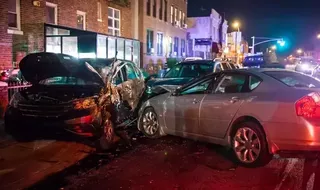
Injured in Phoenix? Sher Law Group represents accident victims across Maricopa County; from the Deck Park Tunnel to South Mountain. Free consultation, available 24/7, and no fee unless we win.
Phoenix is the largest city in Arizona and the center of its freeway network, which means it is also where the most serious collisions in the state happen. Interstate 10 and Interstate 17 cross here. Loop 202, SR-51, and Grand Avenue cut through the grid at angles that create conflict points found nowhere else in the Valley. Add year-round dry driving conditions, wide arterials built for speed, and a population that keeps growing, and the result is a city that generates a very high volume of injury claims.
Sher Law Group is a boutique Arizona personal injury firm. We deliberately take a limited number of cases so that the attorney you speak with on the first call is the attorney who handles your claim through settlement or trial. If you were hurt anywhere in Phoenix, downtown, Ahwatukee, Maryvale, Deer Valley, Laveen, or anywhere between, we can tell you within one conversation whether you have a claim worth pursuing.
Phoenix collision patterns concentrate in a handful of well-known places:
Arizona consistently ranks among the worst states in the country for pedestrian deaths per capita, and Phoenix accounts for a large share of that. Wide multi-lane arterials, long gaps between signalized crossings, and extreme summer heat that pushes foot traffic into early morning and late night hours all contribute.
Arizona's filing deadlines are unforgiving, and the shortest ones apply to exactly the cases people are least likely to recognize as time-sensitive:
If a city bus, a light rail vehicle, a government-owned truck, a dangerous roadway design, or a poorly maintained public sidewalk contributed to your injury, the practical deadline is 180 days; not two years. Cases involving Valley Metro and City of Phoenix vehicles are common, and the notice requirement is routinely missed.
Arizona applies pure comparative negligence under A.R.S. § 12-2505. Your damages are reduced in proportion to your own fault, but your claim is never barred outright. Unlike states that cut off recovery at 50% fault, an Arizona plaintiff found 80% responsible still recovers 20%. Insurance adjusters understand this precisely, which is why the first recorded statement they request is aimed at getting you to accept some share of blame.
Arizona also uses several liability under A.R.S. § 12-2506. Each defendant is generally responsible only for their own percentage of fault rather than the entire judgment. In multi-vehicle freeway collisions, common on the Broadway Curve and at the Stack, correctly apportioning fault among every involved driver, and identifying every applicable insurance policy, is what determines the actual recovery.
On the question of caps: there are none. Article 2, Section 31 of the Arizona Constitution expressly prohibits any law limiting the amount of damages recoverable for causing death or injury. Arizona is one of a small number of states with that protection written into its constitution.
Arizona's mandatory minimum liability limits are $25,000 per person, $50,000 per accident, and $15,000 in property damage. A single night in a Phoenix trauma center can exceed the per-person minimum before treatment even begins. That makes identifying every layer of available coverage the most consequential early step in a serious case:
Phoenix sits in Maricopa County. Civil injury lawsuits are generally filed in Maricopa County Superior Court in downtown Phoenix, with smaller claims proceeding through a Maricopa County Justice Court. Traffic citations issued to the other driver are prosecuted separately in Phoenix Municipal Court. A citation or guilty plea there can support your civil claim, but it does not resolve liability for insurance purposes and cannot be relied on as a substitute for proving fault.
Crash reports for collisions within city limits generally come from the Phoenix Police Department. Collisions on I-10, I-17, Loop 202, Loop 101, and SR-51 are typically investigated by Arizona DPS. Obtaining the correct report quickly matters more than most people expect: officer narratives contain errors, diagrams get reversed, and contributing factors get miscoded; and once an adjuster has built a liability position on a flawed report, it becomes considerably harder to move.
Two years for most claims under A.R.S. § 12-542. If a public entity such as the City of Phoenix or Valley Metro is involved, you must serve a notice of claim within 180 days under A.R.S. § 12-821.01 and file suit within one year under A.R.S. § 12-821. Strict liability dog bite claims carry a one-year deadline under A.R.S. § 11-1020.
Yes. Under Arizona's pure comparative negligence rule, A.R.S. § 12-2505, your recovery is reduced by your share of fault but never eliminated.
Generally in Maricopa County Superior Court in downtown Phoenix, or in a Maricopa County Justice Court for smaller claims. Traffic citations proceed separately in Phoenix Municipal Court.
From the Phoenix Police Department for collisions inside city limits, or from Arizona DPS for crashes on I-10, I-17, Loop 202, and SR-51. Getting the correct report early makes errors in it far easier to address.
No. Article 2, Section 31 of the Arizona Constitution prohibits any law limiting damages for death or personal injury.
Nothing up front. We work on contingency and are paid only from a recovery. The consultation is free.
We also represent injured clients in Scottsdale, Tempe, Mesa, Glendale, Chandler, Peoria, Surprise, and across the rest of Arizona.